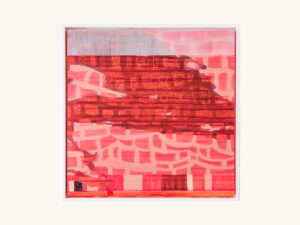
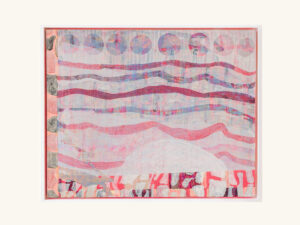
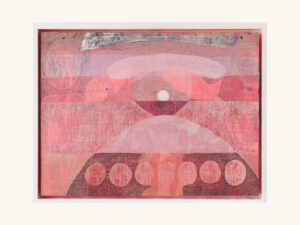
Bruno Grad (b. 1987, Kent, UK) is an artist based at Acme Studios, London. His practice explores painting as a mode of intensified attention, drawing on questions of perception, temporality, and the relationship between material form and transcendence. Working through recursive processes of layering, glazing, repetition, and gesture, Grad’s paintings investigate how aesthetic experience can function as a site of presence and encounter. Informed by Jewish mystical thought and contemporary debates surrounding representation and the image, his work moves between abstraction and symbolic structure to explore painting as a participatory and contemplative act.
Grad received a degree in English Literature from King’s College, Cambridge in 2009. Recent exhibitions include BFAMI 2026 at Phillips, London (2026); Works on Paper 7, Blue Shop Gallery, London (2025); Circling Around at Calder Contemporary, London (2025); Lido Open 2025 at Lido Stores, Margate; and Standing Ground at Thames-Side Studios Gallery, London (2024).
Artist’s statement:
Underlying my practice is an ongoing engagement with the Jewish theological problem of idolatry and the image. I approach idolatry not simply as a prohibition against representation, but as a question about how images produce meaning and how artworks relate to reality. I am interested in the possibility of an image that proceeds synecdochically, which does not merely point to a subject, but participates in a local manifestation of a larger reality. My paintings attempt to translate this metaphysical dynamic into visual language through materiality, edge, interval, pressure, repetition, luminosity, and duration. Built through slow accretions of glazing, rubbing, staining, and layered gestures, the works emerge through processes of attention that are deliberately tactile and recursive. I think of painting as capable of creating occasions in which viewers become conscious of their own presence in time. In this sense, the work attempts to open a space in which perception itself becomes contemplative — where looking might briefly exceed cognition, and where the material surface of painting can function as a threshold rather than a closure. My aim is to construct perceptual situations in which something irreducible can be felt without being fully resolved into language.
Showing all 3 results
Opening hours: 10:30-17:00
Sunday: 11:00-17:00
Tuesday: closed
Wednesday: open during school holidays only